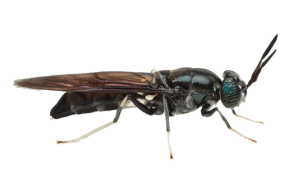
Fish-processing by-products from a community-owned Saskatchewan harvester are now the feedstock for black soldier fly (BSF) larvae that contain measurable levels of the marine omega-3s EPA and DHA — a nutritional profile conventional BSF production has historically struggled to deliver. NRGene Canada and Ile-a-la-Crosse Fish Company Inc. announced on Sept. 16 that a semi-industrial trial has validated the process at commercially meaningful throughput, clearing the path toward an on-site rearing facility in the remote northwest Saskatchewan community.
The Trial Numbers
The validation run, conducted at the North American Insect Center (NAIC) in Saskatoon, processed 0.3 metric tons of feed formulated with 50 percent fish-processing by-products. The run produced approximately 90 kilograms of MaxBSF™ larvae at a wet feed-conversion ratio of roughly 3.3, completing an eleven-day cycle — five days in a nursery stage followed by a six-day grow-out. Independent analysis by Prairie Tide Diversified Inc., a CALA-accredited laboratory in Saskatoon, found the fish-fed larvae contained 5.16% to 7.94% total omega-3 as a share of total fatty acids, compared with 1.12% in control larvae on standard feed. EPA registered at 1.14% to 1.89% and DHA at 0.37% to 0.65% in the fish-fed cohort; neither fatty acid was detected in the standard-feed group. The omega-6 to omega-3 ratio fell to as low as 1.2:1, versus 12.8:1 in controls.
Why the Seafood Link Matters
Fish-processing by-products are notoriously difficult to incorporate into BSF production: high moisture and fat content accelerate spoilage, requiring purpose-built feed recipes, controlled rearing conditions, and high-performing genetics to prevent process failure at scale. The Ile-a-la-Crosse Fish Company — jointly owned by Sakitawak Development Corporation and Big Island Fishermen's Cooperative — generates these by-products from its northern Saskatchewan freshwater fishery. Until now, that material had limited economic use; the partnership converts it into a feedstock that confers marine fatty acids on the resulting larvae, creating what the partners describe as a higher-value input for poultry rations.
"Conventional BSF larvae generally contain very limited levels of EPA and DHA," said Dr. Ben Gradus, Director of Product, BSF at NRGene Canada. "By incorporating fish-processing by-products into the feed, we can produce MaxBSF™ larvae that combine insect protein with valuable marine omega-3 fatty acids." The enhanced profile extends to NRGene Canada's dried larvae product, MaxBites™, positioning it as a potential omega-3-enriched poultry supplement that could elevate omega-3 levels in broiler meat and laying-hen eggs — a value-added claim with growing traction in retail and foodservice channels.
For the seafood supply chain, the arrangement represents a circular-economy close: fish-processing waste that would otherwise require disposal or low-value rendering is upcycled into an aquatic-nutrient-carrying ingredient, effectively recycling EPA and DHA back into the food system through the poultry sector. That dynamic is increasingly relevant to processors facing tightening organic-waste regulations and seeking new revenue streams from trim and offal. The model also parallels efforts in aquaculture feed to replace or supplement fishmeal and fish oil with insect-derived proteins, where traceability of the insect feedstock is becoming a commercial differentiator.
Next Phase
With the feed recipe validated, the partners are scoping an on-site BSF rearing facility in Ile-a-la-Crosse sized to the volume of by-products the local fishery generates. Rearing on-site eliminates transport of a highly perishable feedstock. Neonate supply would flow from FairGene — a joint venture between NRGene Canada and Fairville Farming Co. in Bassano, Alberta — which began producing BSF eggs in July 2026. The arrangement follows NRGene Canada's hub-and-spoke model: centralized genetics and egg production paired with regional rearing units positioned close to local organic-waste streams. Tyler Morin, CEO of Ile-a-la-Crosse Fish Company, called the partnership an expression of the community's sustainability values and noted that local processing keeps jobs and economic value within the community. The on-site facility timeline has not been disclosed. Operators tracking alternative-protein ingredients in foodservice should note that omega-3 provenance claims will depend on consistent feedstock sourcing from verified fishery by-product streams.
Written by Michael Politz, Author of Guide to Restaurant Success: The Proven Process for Starting Any Restaurant Business From Scratch to Success (ISBN: 978-1-119-66896-1), Founder of Food & Beverage Magazine, the leading online magazine and resource in the industry. Designer of the Bluetooth logo and recognized in Entrepreneur Magazine's "Top 40 Under 40" for founding American Wholesale Floral, Politz is also the Co-founder of the Proof Awards and the CPG Awards and a partner in numerous consumer brands across the food and beverage sector.